Table of Contents
Using an exact-cover solver like
DLX from Python
, how can we solve
simple equations like
 where
where
 ?
?
Covering Bits
We'll restrict ourselves to
 so
so
 come from the set
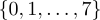 .
Written in binary it contains all 3-bit numbers:
.
Written in binary it contains all 3-bit numbers:
 .
.
If we create one column per bit, we can represent the assignment
 as
as
 since only the least significant bit is set.
The columns
since only the least significant bit is set.
The columns
 still need to be covered.
Now we need to encode
 in a way that covers these
missing columns. The bitwise inverse is
in a way that covers these
missing columns. The bitwise inverse is
 ,
covering exactly
.
,
covering exactly
.
Handling Variable Names
So far, both
and
 would be encoded as a row
with
no way to recover the variable name from the output of DLX.
would be encoded as a row
with
no way to recover the variable name from the output of DLX.
Similarly
 would be encoded as a row
 already
covering all columns, with no need to include
already
covering all columns, with no need to include
 encoded as the
empty row
encoded as the
empty row
 into the solution.
To avoid these issues, we can add a column
 covered by all
assignments to
covered by all
assignments to
 and a column
 covered by all assignments to
 . Now
is encoded as
. Now
is encoded as
 and
is
encoded as
and
is
encoded as
 .
.
As a quick check we can set up the rows for
and
 by hand and verify that the solver finds one solution.
<<init_problem>>

s = Solver()
p = Problem({"va", "vb", "c0", "c1", "c2"})
p.add_row(["va", "c0"])
p.add_row(["vb", "c1", "c2"])

print(s.solve(p))
{'1:': [{'vb', 'c2', 'c1'}, {'c0', 'va'}]}
Encoding and Decoding
For larger sets of input numbers, we'll want to automate the encoding and decoding of rows.
Inverting a k-bit binary number is equivalent to subtracting it
from
 , a number where the lowest
 bits a all 1.
For example
 , so the inverse of
 is
is
 .
.
def invert(val: int, n_bits: int) -> int:
    full = (2**n_bits) - 1
    return full - val
To encode an assignment of
var = val
, we invert
val
if
var
is
"b", then read bits one by one to determine which columns are covered.
def encode_row(var: str, val: int, n_bits: int):
    if var == "b":
        val = invert(val, n_bits)

    res = {f"v{var}"}
    for i in range(n_bits):
        if val & 1 == 1:
            res.add(f"c{i}")
        val //= 2
    return res
When decoding, we add the powers of two corresponding to the covered
columns and invert again
val
if
var
is "b".
def decode_row(row: set[str], n_bits: int) -> tuple[str, int]:
    var = None
    val = 0

    for col in row:
        if col[0] == "v":
            var = col[1:]
        elif col[0] == "c":
            val += 2**int(col[1:])

    assert var in ("a", "b")
    if var == "b":
        val = invert(val, n_bits)
    return (var, val)
To decode a solution, we decode rows one by one and collect the values assigned to each variable (here just "a" and "b").
def decode_solution(solution: Solution, n_bits: int):
    res = {}
    for row in solution:
        var, val = decode_row(row, n_bits)
        if var in res:
            raise KeyError("Duplicate assignment")
        res[var] = val
    return res
Finally we can connect everything and verify that the solutions to
 are in fact
 ,
,
 , …,
, …,
 .
.
<<init_problem>>
<<invert>>
<<encode>>
<<decode>>
<<decode-solution>>

s = Solver()
p = Problem({"va", "vb", "c0", "c1", "c2"})

n_bits = 3
for i in range(2**n_bits):
    p.add_row(encode_row("a", i, n_bits))
    p.add_row(encode_row("b", i, n_bits))

solutions = s.solve(p)

for solution in solutions.values():
    print(decode_solution(solution, n_bits))
{'b': 3, 'a': 3}
{'a': 6, 'b': 6}
{'b': 0, 'a': 0}
{'a': 7, 'b': 7}
{'b': 1, 'a': 1}
{'a': 4, 'b': 4}
{'b': 2, 'a': 2}
{'a': 5, 'b': 5}